


How e-learning brings change processes to life
These days, you hear the phrase “We need to transform” in almost every company. Yet whilst some are still debating technologies, others are already failing at implementation. Why? Because digital transformation isn’t just about new tools; it also requires a profound shift in mindsets, processes and cultures. And this is precisely where an often-underestimated factor comes into play: e-learning.
Not as a rigid online course or a mere means of imparting knowledge, but as a dynamic, interactive companion that not only informs employees but also empowers, motivates and engages them in the change process. How does this work? Join us on a journey through the three crucial phases of digital transformation and discover how e-learning becomes a game-changer at every stage.
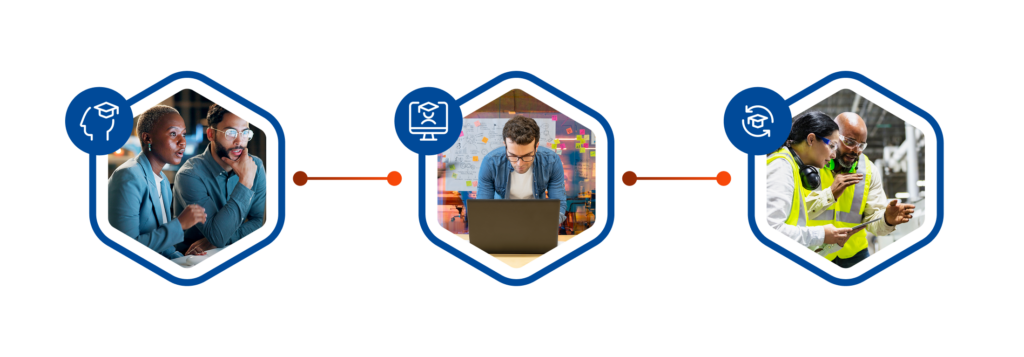
Phase 1: Educate – Why change is necessary.
In many companies, digital transformation begins with an announcement from senior management: ‘From next month, we’ll be using System X.’ However, if the workforce does not understand why this change is necessary, resistance arises. Studies show that more than 40 per cent of change projects fail because the need for them is not clear to employees.

Storytelling instead of PowerPoint!
We are convinced that a good story in an interactive e-learning module can stir emotions and thus foster acceptance. A presentation of dry facts and new procedures, on the other hand, leads to rejection.
The following options are available:
- Interactive infographics showing how the industry is changing.
- Short video statements from senior managers personally explaining why the change is necessary.
- Gamified quizzes that convey knowledge in a playful way.
Why this works:
A study by Stanford Research has shown that our brains process stories and visual stimuli 22 times more effectively than bare facts. Another key point when communicating change is that employees need to be emotionally engaged in order to buy into it.
Phase 2: Empower – Building skills for the new world
Even when everyone understands the need for change, implementation often falls short. This is because as soon as new software, revised workflows, agile methods or data-driven working are introduced, new skills and knowledge are required. Traditional face-to-face seminars are often too slow, too expensive and too inflexible for this purpose.
Learning in the Flow of Work
Acquiring new skills is most effective when they can be integrated directly into day-to-day work. E-learning is an interactive method that enables precisely this and promotes practical, immediately applicable learning.
The following options are available:
- Software simulations in which employees can try out how the new system or workflow functions, risk-free.
- Scenario-based training courses that replicate real-world challenges.
- Micro-learning modules that provide guidance or fill information gaps in 5–10 minutes.

A real-world example:
A large logistics company introduced a new warehouse management system. Instead of weeks of training, the company opted for interactive e-learning modules. These allowed staff to familiarise themselves with the system virtually and practise new workflows.
The result:
- 50% faster induction time.
- 30% fewer errors in the first few weeks.
- 90% of staff felt better prepared.
Why this works:
As early as 1984, Kolb demonstrated that our brains learn best when we take action ourselves and receive immediate feedback. E-learning creates precisely these spaces for experimentation, without the risk of real-world mistakes, and provides constructive feedback.
Phase 3: Embedding – making change sustainable
The biggest mistake in change processes is the assumption that all work is complete once the rollout is finished. However, digital transformation is not a project with a fixed end date, but rather a continuous improvement process. If daily learning stops, the newly acquired skills will also fade.

Learning as a dynamic process
The embedding of new skills can be promoted through the correct use of interactive self-learning materials. For long-term success, e-learning should play a central role in the process, as this is the only way it can have its full impact.
The following options are available:
- Collaborative: Employees are actively encouraged to share experiences and support one another.
- Interactive: Exploring information, acquiring skills and receiving constructive feedback all help to build competence.
- Practical: Simulating real-life situations, dialogues or everyday processes deepens the learning experience and allows for risk-free experimentation.
- Data-driven: Analyses reveal which content is actually being used and where there is a need for further training.
- Agile: Content is continuously updated and adapted to the results in order to keep pace with the transformation.
- Personalised: The materials are designed to be tailored to the learners’ needs and level of knowledge.
A real-world example:
A financial services provider wishes to enhance its efficiency and customer focus. To this end, it aims to improve its focus on customer needs using agile working methods. As part of a holistic approach, rather than one-off training sessions, the company relies on:
- An adaptive learning approach to respond flexibly to learners’ needs and their current level of knowledge.
- Practical micro-learning units to quickly integrate what has been learnt into everyday work.
- Regular ‘refresher courses’, such as quarterly updates on new processes.
- An internal knowledge database where staff can learn from one another and share best practices.
- Gamified challenges and learning approaches facilitate change and help staff apply what they have learnt quickly.
The result:
- Acceptance of agile methods rose from 40% to 85% within a year.
- The time taken to process customer enquiries fell by 20%.
Why this works:
To achieve sustainable learning outcomes, it must not be a one-off event. Bandura established this as early as 1977. Learning is a social and iterative process. Employees should therefore learn slowly and continuously. They should understand the process and practise applying it in order to successfully put what they have learnt into practice. When they discuss the change and are able to explain the new approach, the change becomes second nature.
The science behind it: Why e-learning works in change management
E-learning is neither a ‘digital textbook’ nor a ‘digital flashcard system’. Rather, it is a scientifically grounded tool based on proven principles of learning psychology. It makes targeted use of mechanisms and methodologies designed to make learning and knowledge transfer more efficient, sustainable and motivating.
For example, new systems or processes are not taught through a manual, but via a practical simulation or scenario. The learner tries out the method for themselves, sees the consequences and thus retains up to 60 per cent more. Active learning is crucial to learning success.
Learning within a social context is equally helpful. Exchanging ideas with colleagues leads to valuable insights and discoveries. Everyone can learn from others’ experiences and benefit from how these challenges were overcome. This boosts motivation and acceptance across the whole team.
The key to embedding what has been learnt in the long term is regular revision or repetition. Furthermore, gamification, adaptability and interactivity contribute to the appeal of the programme.
A clear definition of learning objectives in line with Bloom’s taxonomy is crucial for success, to ensure that the content is not only conveyed but also understood, applied and transferred.
E-learning as a driver of digital transformation
Digital transformation is not a purely technical process, but a socio-technical change that affects people, processes and culture in equal measure. It is not enough simply to use technology; employees must also understand it, accept it and implement it in their day-to-day work. Only then can sustainable change take place.
This requires more than just information. What is needed is a structured approach that addresses three key phases:


1. Awareness
(Why are we changing?)
The first hurdle in the change process is accepting the change. This is achieved through clear communication of the necessity, the vision and the objectives. With the help of interactive formats such as videos, storytelling and visual representations, the reasons for the transformation are conveyed in an emotional and informative way.
2. Empowerment
(How do we do it?)
Once there is awareness of the need for change, the focus shifts to building the necessary skills. In this phase, staff must learn to apply the new tools, processes or methods in practice. Interactive elements are used not only to impart theoretical knowledge but also to develop practical skills.




3. Embedding
(How do we ensure the change is sustainable?)
The greatest challenge lies in embedding the change for the long term. To consolidate the skills acquired, it is important to encourage open and transparent dialogue, reinforce what has been learnt and identify gaps in knowledge. Without continuous support and repetition, knowledge quickly fades and old habits return.
E-learning is the tool that links all three phases together. It is scalable, flexible and measurable. It is not a ‘nice-to-have’, but a strategic lever for successfully shaping digital transformation. After all, it is not just about introducing technology, but also about getting people on board. However, this can only be achieved through awareness, empowerment and embedding.